
ShatterCrypt — A Self-Refactoring, Quantum-Safe Encryption Protocol
A conceptual protocol that self-mutates and self-destructs with every use
By Tom Greenwood
Abstract
ShatterCrypt is a conceptual encryption protocol designed to contain compromise risk by refactoring itself with every use. Each message becomes a unique cryptographic event with no cipher reuse, no shared key structure and no deterministic residue.
Executive Summary
As the quantum era approaches, our assumptions about cryptographic permanence must be re-evaluated. Traditional encryption models, even those deemed quantum-safe, risk systemic compromise if exposed or intercepted in the future. ShatterCrypt introduces a conceptual encryption protocol designed to radically contain compromise risk by self-refactoring with each use, leaving no reusable patterns, no decipherable metadata, and no pathway for retrospective decryption.
Core Problem
Current quantum-safe cryptography focuses on defending specific mathematical problems, such as lattice-based and hash-based constructions. But these still expose ciphertext structures, key exchange mechanisms, and traffic patterns. If any part of the system is compromised, there is potential for wide-scale exposure: what we term cryptographic contagion.
Vision
ShatterCrypt is a blueprint for a radically decentralised encryption model. Every message is a unique cryptographic event. There is no cipher reuse, no shared key structure, no persistent metadata, and no residue. If intercepted, a message is isolated in time and space, a cryptographic singularity.
Design Principles
Ephemeral Quantum-Safe Keying
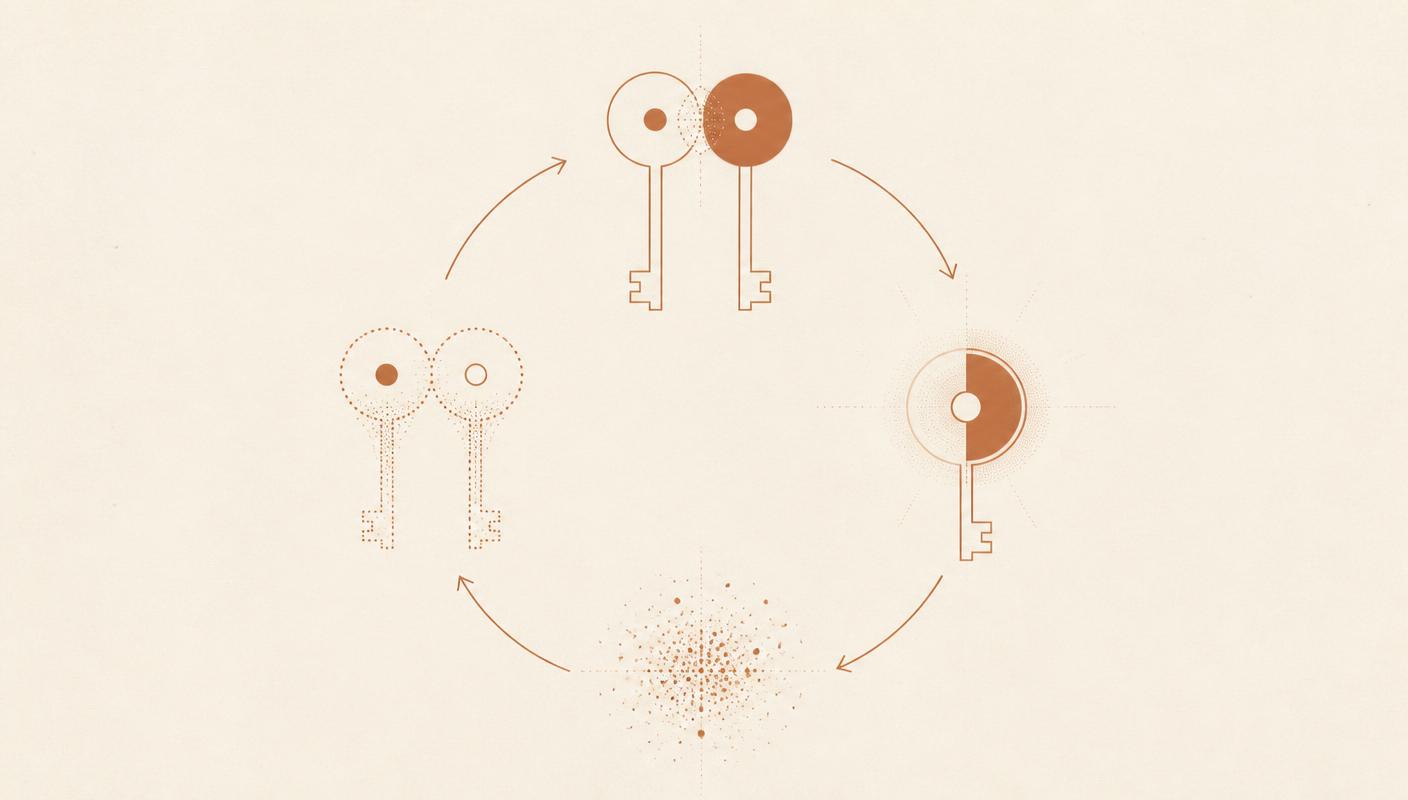
The protocol uses post-quantum cryptographic primitives to derive session-specific symmetric encryption keys that are both ephemeral and quantum-resistant.
We adopt lattice-based schemes, principally ML-KEM (FIPS 203), the standardised form of Kyber, approved by NIST in August 2024. Each encryption session uses a Key Encapsulation Mechanism (KEM) to negotiate a one-time symmetric session key.
Isogeny-based constructions such as CSIDH are included only as a diversity hedge, not as a standardised primitive. Their classical security is intact, but concrete quantum security levels remain contested: Bonnetain and Schrottenloher and Peikert argue the original parameter sets are substantially weaker than first claimed, and the SQALE response revises sizing upward. Any should treat isogeny parameters as unsettled.
The key exchange is authenticated using long-term digital signatures, specifically ML-DSA (FIPS 204), the standardised form of Dilithium, ensuring secure identity validation without compromising forward secrecy. These identity keys are used strictly for authentication and never for encryption or direct session derivation.
Each message derives:
- A one-time ephemeral keypair, created on the fly
- A session key derived via KEM using lattice or isogeny parameters
- Real-time entropy, such as system noise or a secure PRNG, to randomise even under adversarial scrutiny
Post-use, both the session key and the ephemeral keypair are irreversibly destroyed. This design eliminates long-term key exposure, supports forward secrecy in the standard sense, and raises the cost of harvest-now-decrypt-later attacks. It does not deliver information-theoretic secrecy, and the guarantee is only as strong as the key destruction routine described below.
Per-Message Cipher Refactoring

Each encryption instance generates its own cipher configuration. This configuration governs:
- Block size and mode, such as CBC, GCM, or custom
- Padding and framing rules
- Substitution-permutation structure
- Entropy and IV-generation mechanisms
These parameters are embedded in the payload and encrypted with the ephemeral key. Encryption alone is insufficient: the parameter block must also be cryptographically committed to the key, nonce and associated data. Recent committing-security work shows that ciphertexts which fail to bind their context can be made to decrypt correctly under a second, attacker-chosen context, in zero-padded Ascon and in HCTR2. For a protocol whose cipher descriptor travels inside the ciphertext, a non-committing mode is a structural flaw, not a detail.
The result: no two messages use the same cryptographic shape, even from the same sender.
This prevents ciphertext correlation, resists pattern mining, and ensures that bulk traffic analysis is computationally futile.
Zero-Knowledge Proof Attachment
Each message is bundled with a zero-knowledge proof (ZKP) to ensure verifiability without revealing sensitive information. ZKPs can prove:
- The sender was authenticated without revealing their key
- The message structure conforms to protocol without exposing format
- Integrity checks without exposing hash values or metadata
ZKPs can be constructed using zk-SNARKs or STARKs, depending on computational requirements. Optional anonymity sets allow privacy-preserving sender identity proofs, for example proving membership in a group without revealing which member.
Post-Use Cryptographic Erosion
To enforce non-reusability, ShatterCrypt includes a cryptographic burn routine:
- Secure key and memory wipe after use
- Destruction of metadata, IVs, and structural logs
- Optional logging of destruction as part of a deletion log
A deletion log records an intention to delete. It is not a cryptographic proof of erasure, and it should not be presented as one. Genuine requires either a certified-deletion primitive or a hardware-enforced key store, and the honest claim is that erosion is enforced at implementation level rather than proved.
Decentralised Traffic Obfuscation

Protocol messages can optionally be wrapped in formats mimicking conventional traffic such as:
- Video streaming headers
- TLS 1.3 handshake sequences
- DNS-over-HTTPS patterns
This allows traffic to blend in with everyday internet use, mitigating surveillance-level metadata detection. Obfuscation is modular and supports plug-ins tailored to specific environments.
Protocol Flow
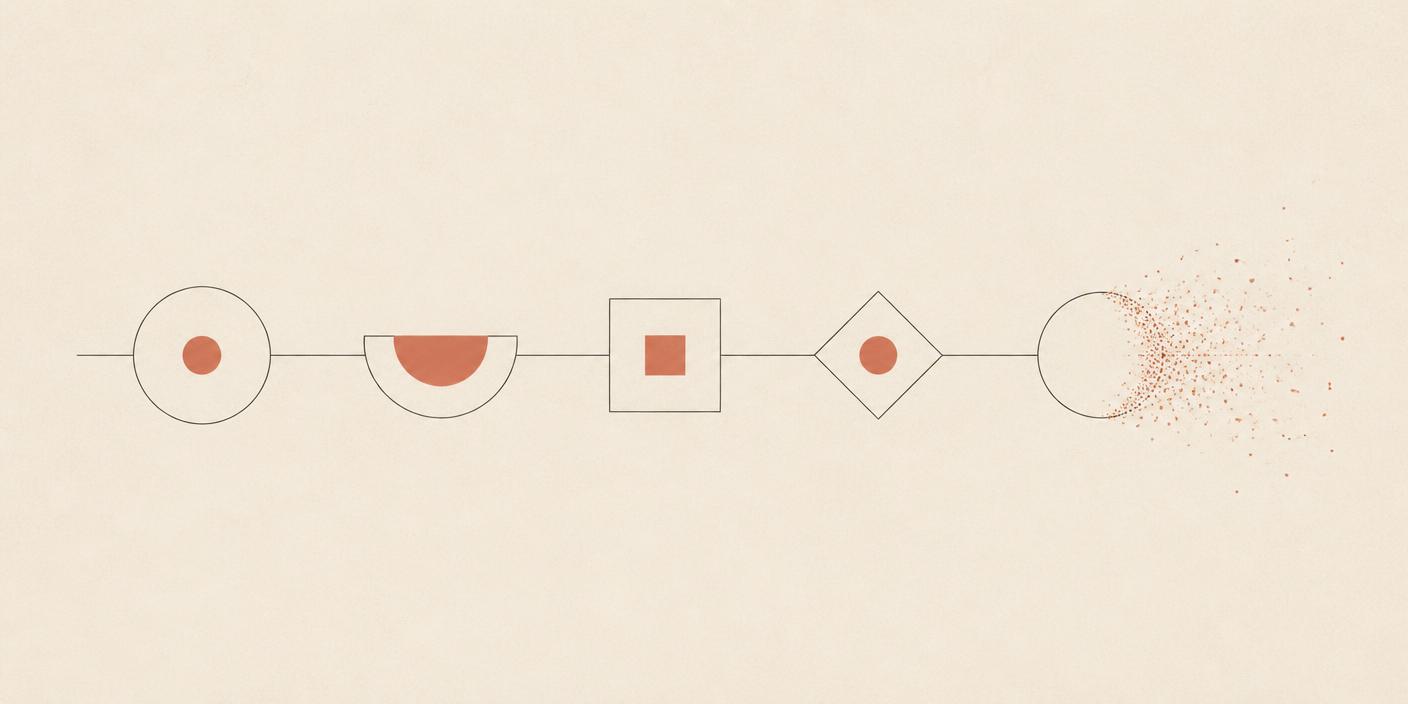
Initial authentication. Each party uses long-term identity keys to verify the other. No encryption occurs with long-term keys, identity only.
Ephemeral key generation and exchange. Ephemeral keypairs are generated, a KEM derives the shared session key, and random entropy is added to prevent determinism.
Message construction. The message is encrypted using a dynamic cipher scheme, the cipher parameters are encrypted and included in the payload, and a ZKP is generated and attached.
Message transmission. An optional traffic masking layer is added and the message is sent with no metadata or time markers.
Decryption and verification. The recipient uses the ephemeral key to decrypt the payload, the ZKP is verified, and a destruction routine securely wipes session data.
Security Posture
- Forward secrecy. Ephemeral keys ensure past sessions cannot be decrypted even if long-term keys are compromised.
- Post-quantum resilience. Based on NIST-recognised quantum-safe primitives.
- Minimal observable metadata. No timestamp, sender ID, or cipher suite is carried in the payload. Packet timing, size and volume remain observable to a network-level adversary, so this is metadata reduction, not metadata elimination.
- Resilience to replay. Session-specific ciphers ensure replayed ciphertext is useless.
- Traffic camouflage. An optional layer masks communication in regular internet flows.
Applications
- Post-quantum secure messaging. Platforms that require durable forward secrecy against future-state attackers.
- Government communications. State-level defence, intelligence, and diplomatic use cases.
- Financial transactions. Isolation of transaction sessions in high-risk environments.
- Decentralised infrastructure. Use in blockchain, Web3, and distributed protocols.
Implementation Considerations
- Hardware root of trust. The erosion guarantee assumes a trustworthy key store. Commodity TEEs are a weak foundation for that assumption: SoK: SGX.Fail catalogues repeated practical breaks of Intel SGX, which has since been withdrawn from consumer-class CPUs. Treat a TEE as defence in depth, never as the sole basis for erosion.
- Randomness sources. High-entropy RNGs are essential for security.
- Auditability. ZKP logs can be retained for later verification without revealing content.
- Extensibility. A modular design allows cryptographic primitives to be swapped as standards evolve.
Related Work and Open Questions
Ephemeral keying and ratcheting. The closest formal grounding for keys that expire by construction is post-quantum ratcheting. RHQC builds ratcheted key exchange from coding assumptions, and Ilyazh-Web3E2E augments the Double Ratchet with hybrid X25519 and ML-KEM encapsulation for forward-secure decentralised messaging. On the cost objection, DAKE shows how much of the bandwidth overhead of double-KEM authenticated key exchange can be recovered.
Cipher agility and self-refactoring. Agility can be verified rather than asserted: topology-driven symbolic verification of post-quantum migration paths uses the Tamarin prover to check that a migration path preserves protocol-level guarantees. More pointedly for a protocol that rewrites itself, subversion-resilient key exchange in the post-quantum world treats a tampered implementation as the adversary.
Traffic-shape obfuscation. Flexible in-network obfuscation, presented at USENIX NSDI 2026, sets the current bar for defending against traffic analysis, while Bytes to Schlep? Use a FEP formalises exactly what fully encrypted protocols do and do not hide. Both suggest that wrapping alone is insufficient without shaping.
Key exposure and erosion. Work on key-exposure-resilient sharing with fine-grained revocable access control is the nearest deployed analogue to time-bounded decryptability.
Where the Literature Pushes Back
Combiner fragility. The X-Wing case study shows that optimised hybrid KEM combiners lose their security proofs without public context binding. Swapping primitives per message is therefore not free, and a refactoring engine could compose two individually sound primitives into an unsound whole.
The implementation is the attack surface. Subversion-resilience research assumes an adversary who has tampered with part of the implementation. Code that rewrites its own cipher configuration in the field is, by design, a system where such tampering is hardest to distinguish from intended behaviour.
Non-committing ciphertexts break the proof layer. Without commitment, a per-message cipher descriptor can be reinterpreted under a second context, and the zero-knowledge layer would then verify the wrong object with perfect fidelity.
None of these are fatal. They are the specific places where ShatterCrypt currently states an ambition rather than a result, and they define the research agenda for a reference implementation.
Conclusion
ShatterCrypt proposes a radical shift in encryption design: from key-hardening to structural immunisation. Each cryptographic use self-mutates and self-destructs, preventing compromise contagion.
In a world of nation-state actors, quantum threats, and long-term surveillance, ShatterCrypt represents a future-facing cryptographic immune system: decentralised, unpredictable, and uncompromising.
Next Steps
We are seeking partners and contributors in the following areas:
- Applied cryptography and quantum-safe primitives
- Secure messaging platforms
- Government and enterprise security
- Zero-knowledge proofs and verifiable deletion
For technical collaboration, implementation pilots, or interest in licensing, please get in touch.