Before the spreadsheet: the tally sticks
By Tom Greenwood
In October 1834, Parliament burned down because someone was clearing out old receipts.
For more than 700 years, from at least the early 1100s, England's Exchequer recorded payments on tally sticks. Even the name comes from a chequered cloth on the table, where officials moved counters to do the sums.
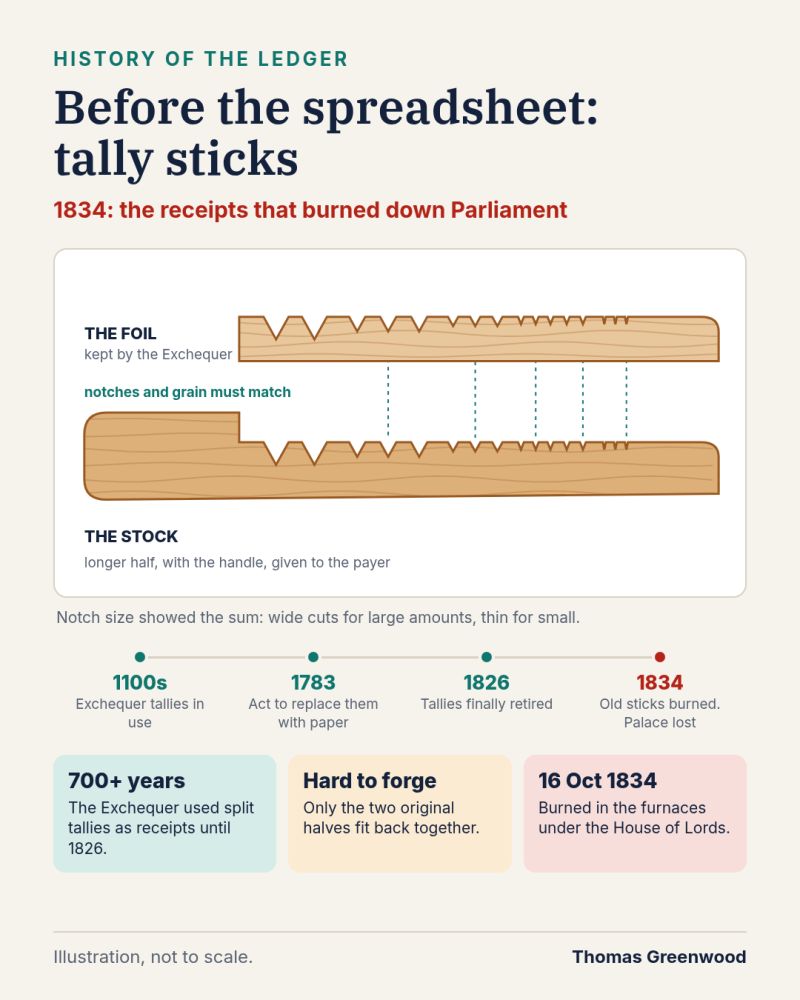
A tally was a stick of seasoned wood, often hazel or willow. Around 1179 the royal treasurer Richard FitzNeal set out the notches in his Dialogue concerning the Exchequer: a palm's width for £1,000, a thumb for £100, a swollen barleycorn for £1, a scratch for a penny.
The clever part was the split. The notches were cut first, then the stick was split lengthways, so both halves carried the same notches and the same grain. The longer half, the stock, went to the payer as his receipt. The shorter foil stayed with the Exchequer, so nobody could confuse the two.
Now imagine a sheriff tempted to cheat. Add a notch to his stock and it no longer matches the foil. Shave one off and the gap shows when the halves meet. Carve a fresh pair and the grain never lines up. When he came to account at the Exchequer, his stock was fitted to the foil, and only then was he credited on the Pipe Roll, while separate scribes kept matching rolls word for word. As FitzNeal put it, "a threefold cord is not quickly broken".
By the 1300s the Crown also handed tallies to creditors as a claim on taxes not yet collected, and some seem to have been sold on at a discount. A protest song of the time mocked Edward III for eating off silver while paying with wooden sticks.
The Receipt of the Exchequer Act 1783 replaced the sticks with paper receipts checked against a counterfoil, but only once the officials who cut them had died. The last chamberlain died in 1826.
That left two cartloads of obsolete sticks. On 16 October 1834 they were fed into the stoves under the House of Lords. The flues overheated, and by morning most of the old Palace of Westminster had gone. Turner watched and painted it twice. In 1855 Dickens put it best: "The stove, overgorged with these preposterous sticks, set fire to the panelling; the panelling set fire to the House of Lords; the House of Lords set fire to the House of ."
A little survives in the language. The stock is often said to be where "stockholder" comes from. And we still prove things by matching our copy against someone else's, only now the copies are digital.
Every record system is a way of agreeing what happened. Some are just more flammable than others.
Sources: Richard FitzNeal, Dialogus de Scaccario (c.1179); Receipt of the Exchequer Act 1783 (23 Geo. 3 c. 82); W. T. Baxter, "Early accounting: the tally and checkerboard", Accounting Historians Journal 16(2), 1989; T. Moore, "Score it upon my taille", Reading Medieval Studies 39 (2013), pp. 1-24; UK Parliament, "Tally sticks"; Charles Dickens, speech at Drury Lane, 27 June 1855.
Originally published on LinkedIn on 21 October 2026.
Views my own. Not endorsed by or affiliated with HM Treasury.