Before the spreadsheet: writing may have started as bookkeeping
By Tom Greenwood
Some of the earliest writing we have isn't poetry or law. It's receipts.
Around 3300 BC, in Uruk in what is now southern Iraq, scribes pressed marks into wet clay with a reed: a number, a sign for barley or beer, sometimes an office or a person. About 5,000 of these early tablets survive, most from Uruk's Eanna temple district, many of them later dumped as fill under new buildings. As the Assyriologist Robert Englund notes, on average about 85% are administrative accounts. Most of the rest are lists of signs, probably used to train the people who wrote them.
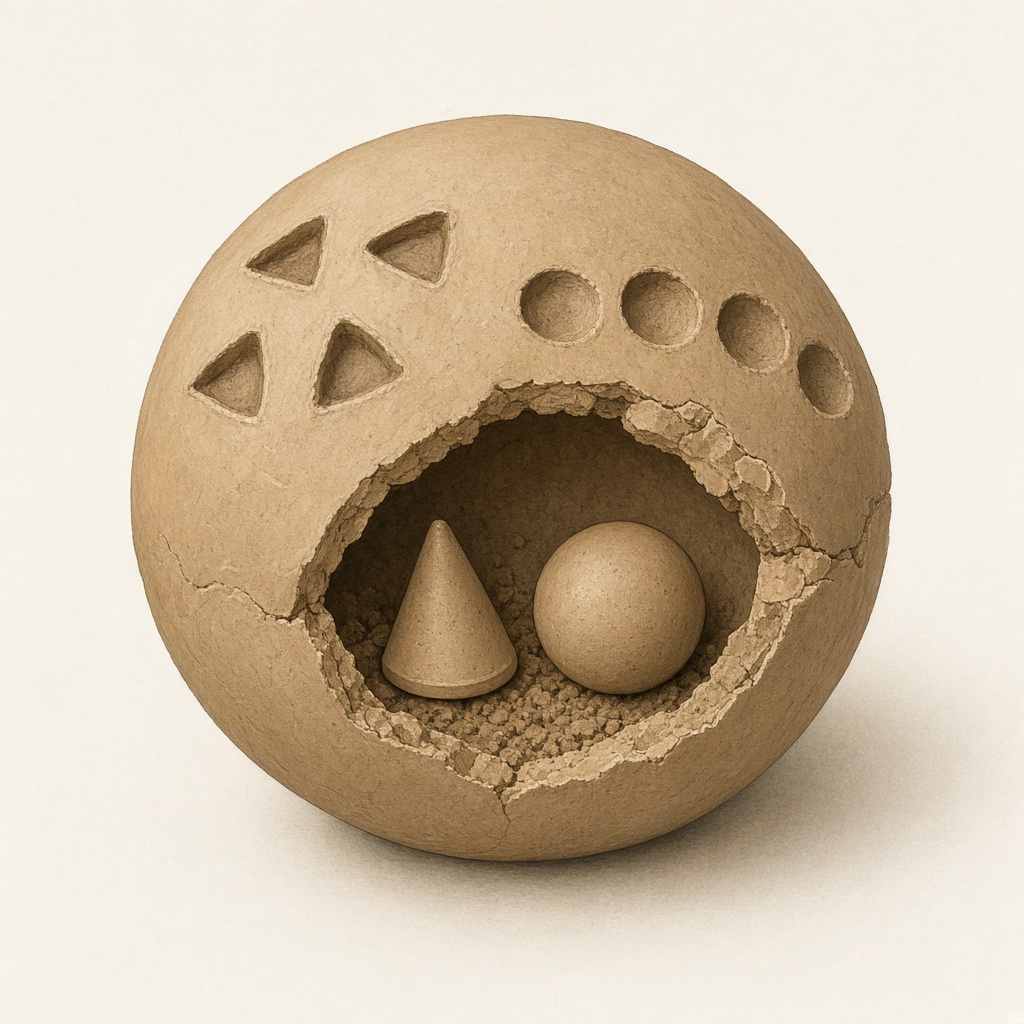
The archaeologist Denise Schmandt-Besserat traced a longer story in her 1992 book Before Writing. For thousands of years before that, people across the Near East counted with small clay tokens: a cone for a small measure of grain, a sphere for a larger one. Some were sealed inside hollow clay balls, probably as a record of something owed. To show what was inside without breaking the seal, someone pressed the tokens into the outside first. One such envelope from Susa, in south-west Iran, is now in the Louvre.
Specialists still argue over how far tokens shaped the later signs. Reviewing her book in 1993, the archaeologist Paul Zimansky called the result "devastating" for her wider theory. But on one point there's broad agreement: the numbers came first. The oldest tablets carry numerals and nothing else.
The Assyriologist Niek Veldhuis puts it neatly. The more complex accounts, he writes, are "more like a modern spreadsheet than a modern writing system".
The first thing we wrote down, it seems, was who owed what.
#HistoryOfIdeas
Sources: R. K. Englund, "Proto-cuneiform account-books and journals", in M. Hudson and C. Wunsch (eds), Creating Economic Order (2004), p. 28; D. Schmandt-Besserat, Before Writing, vol. 1 (1992); P. Zimansky, review, Journal of Field Archaeology 20 (1993), p. 513; N. Veldhuis, "Cuneiform: changes and developments", in S. D. Houston (ed.), The Shape of Script (2012).
Originally published on LinkedIn on 29 October 2026.
Views my own. Not endorsed by or affiliated with HM Treasury.