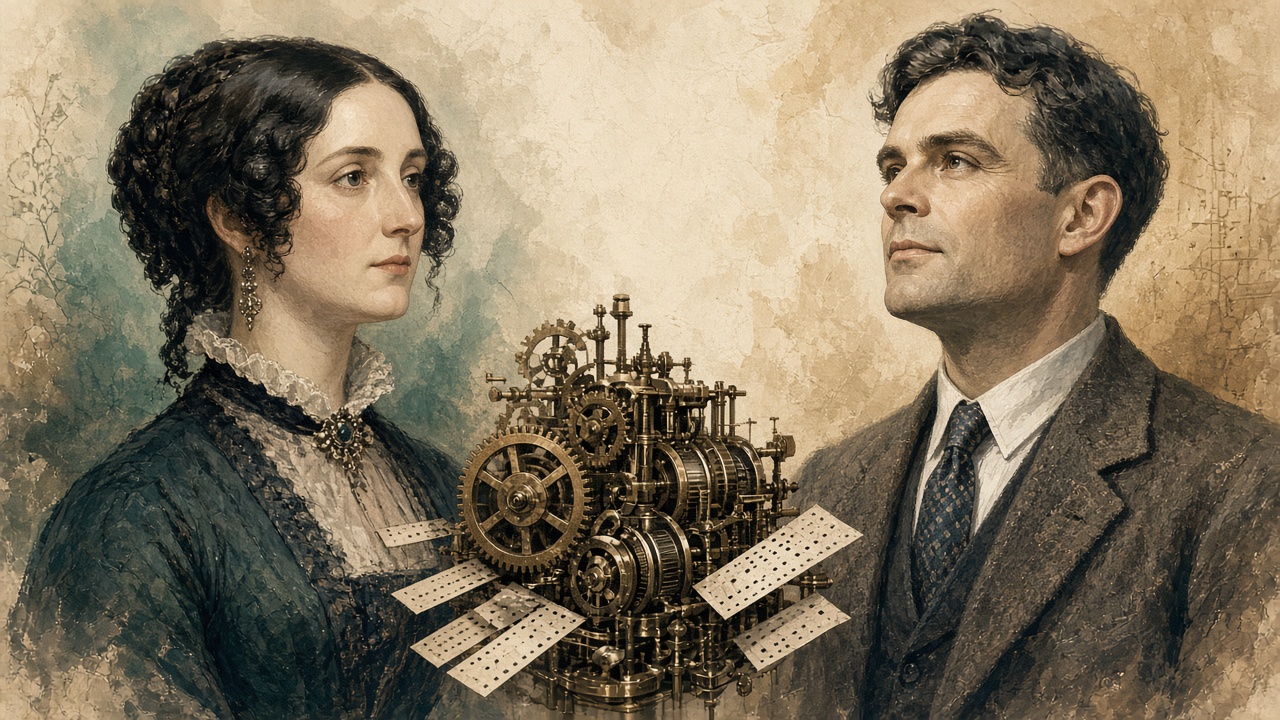
Who surprised you? Lovelace, Turing and the machine
By Tom Greenwood
A thought experiment. You give a machine a job, go and put the kettle on, and come back to an answer you did not expect.
Who surprised you? The machine, or the version of you who wrote its instructions?
The case for "you" is strong, and very old. In 1843, writing about Babbage's Analytical Engine, a machine that was never built, Ada Lovelace put it plainly in Note G: "The Analytical Engine has no pretensions whatever to originate any thing. It can do whatever we know how to order it to perform."
On that view, nothing comes out that you did not put in. The surprise is yours, just delivered late. It is hard to argue with.
But that is where it gets interesting. If a machine's surprises are only our own forgotten instructions, how many of our surprises are any different?
Alan Turing took this on in 1950, in "Computing Machinery and Intelligence", under the heading "Lady Lovelace's Objection". His reply: "Machines take me by surprise with great frequency."
His reason is honest rather than grand. He does his sums "in a hurried, slipshod fashion, taking risks". He assumes the voltage here is the same as there, and "by the time the experiment is done these have been forgotten." So the machine hands his own assumptions back to him, and they feel new.
That half concedes Lovelace's point. The other half turns it round. Who can be certain, Turing asks, that "original work" he has done "was not simply the growth of the seed planted in him by teaching"? Apply her rule fairly and it covers us too.
A small example. A holiday budget spreadsheet insists you are £400 over. You trace it back and find the exchange rate you typed in last spring and never looked at again. The spreadsheet did exactly what it was told. It still surprised you.
Then the other half. The clever idea you had for fixing it turns out, on inspection, to be something a teacher said years ago, probably in a maths lesson you were only half listening to. You did not invent it so much as find it again, sitting where it had been all along, waiting for the right problem to come along.
So, back to the kettle. Who surprised you? Lovelace would say you did. Turing would agree, then ask who surprised you before that. His last word is that noticing a surprise takes as much of a "creative mental act" whether it comes from "a man, a book, a machine or anything else."
The answer may not be original. Spotting it still is.
Sources: A. A. Lovelace, Note G, in L. F. Menabrea, "Sketch of the Analytical Engine invented by Charles Babbage", trans. with notes by A. A. L., Scientific Memoirs 3 (1843), pp. 666-731; A. M. Turing, "Computing Machinery and Intelligence", Mind 59(236) (1950), pp. 433-460, s. 6(6).
Originally published on LinkedIn on 30 October 2026.
Views my own. Not endorsed by or affiliated with HM Treasury.