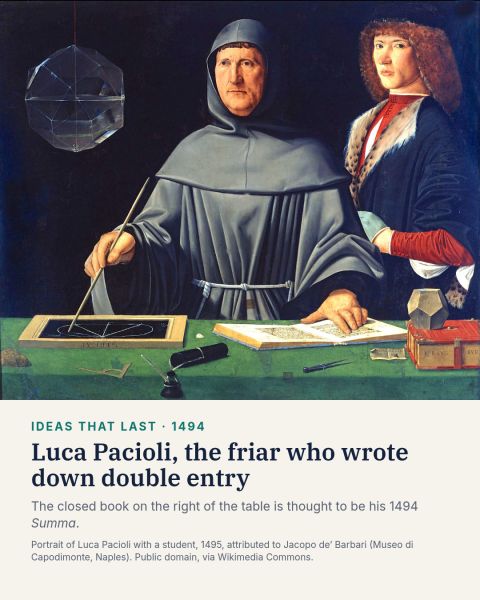
Pacioli, 1494
By Tom Greenwood
In November 1494, a Franciscan friar in Venice published a maths textbook. Tucked inside it was the earliest known printed treatise on bookkeeping, and it shaped how the world keeps track of money.
The friar was Luca Pacioli. The book, the Summa de arithmetica, geometria, proportioni et proportionalità, was printed by Paganino de Paganini in Venice.
Its bookkeeping section is remembered as the first published description of double-entry accounting: every transaction recorded twice, so the books can be checked against themselves.
Pacioli didn't invent the method. He wrote down the practice Venetian merchants already used and taught it to anyone who could read. That's why he's often called the "father of modern accounting".
(A side note: he later became a close friend of Leonardo da Vinci.)
What strikes me is that the core problem hasn't changed in 500 years. Whenever money moves, someone has to keep a record that everyone trusts.
Double entry answered that with a method rather than a promise. The check is built into the record itself: if the two sides don't balance, you know something is wrong. The question behind it never goes away: why should anyone believe what's in front of them?
Which older idea do you think still quietly shapes how we work today?
#HistoryOfIdeas
Originally published on LinkedIn on 15 October 2026.
Views my own. Not endorsed by or affiliated with HM Treasury.